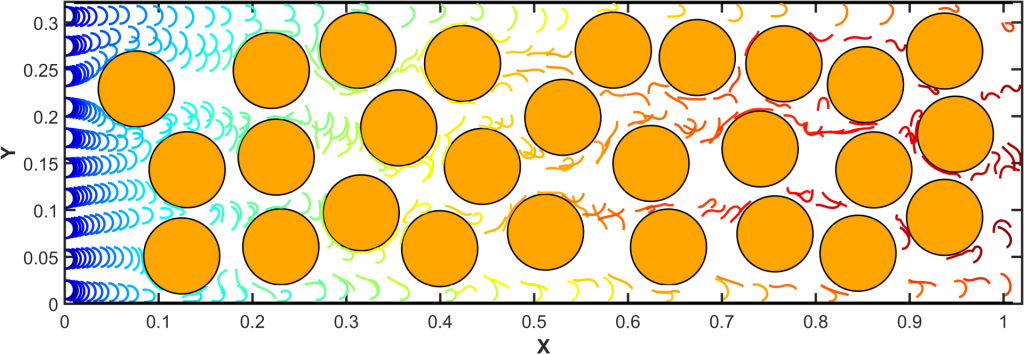
Deformable fibers around circular obstacles
I investigate how particle deformation and circular obstacles affect the migration and retention of thread-like particles in perforated media.
Stochastic and semi-analytical models of particle motion, memory, and breakthrough in porous media.
I investigate anomalous transport of elongated, deformable particles, including microplastic fibers, in microstructured and porous media. Anomalous, or non-Fickian, transport describes spreading and arrival patterns that depart from classical diffusion models.
I examine how obstacle geometry and heterogeneous waiting times shape particle retention and arrival. The objective is to connect local transport mechanisms with observable behavior at larger scales.
I investigate how particle deformation and circular obstacles affect the migration and retention of thread-like particles in perforated media.
I use continuous-time random walks (CTRW) to represent particle motion as steps separated by waiting times. I study shifted generalized-gamma distributions and memory-dependent formulations to describe heterogeneous travel times and delayed transport.
I analyze first-passage times—when particles first reach a boundary—and breakthrough curves—how particle arrivals vary over time—to characterize delays and the influence of geometric heterogeneity.
I develop semi-analytical formulations for diffusion and first-passage problems with circular boundaries and multiple cavities, using Laplace transforms, Fourier representations, modified Bessel functions, and multipole expansions.
I also contribute to a review of continuum, pore-scale, and stochastic frameworks for microplastic transport. See Publications for the manuscript and its current status.
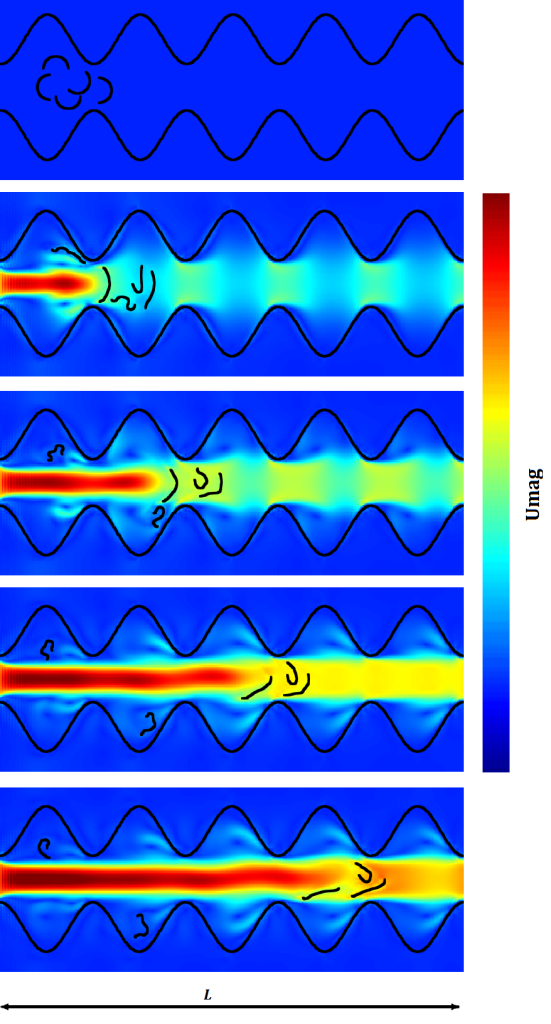
These figures from Prof. Mojdeh Rasoulzadeh’s research page illustrate particle-scale transport in the geometries that motivate my research.